
- The full timeline of how we got here
- The price of entry and why it's deliberate
- Who got in first: the brands, agencies, and ad tech
- The ad formats what users actually see
- Privacy rules, user controls & ad safeguards
- The backlash and why OpenAI should have seen it coming
- Why OpenAI had no choice
- What marketers should do right now?
- The bigger picture a market splitting in real time
- FAQs: quick answers for marketers
- The bottom line
For years, ChatGPT was the clean room of the internet, no banner ads, no pop-ups, no sponsored results. Just you and the most powerful AI assistant ever built. Then, on the morning of February 9, 2026, that changed forever.
OpenAI flipped the switch on advertising. And while the industry had been bracing for this moment, the actual reality, the pricing, the minimum spend, the named brands, the ad tech infrastructure, the user backlash caught even seasoned marketers off guard.
Here’s the full story
| Feb 9, 2026 Official Ad Launch | $60 CPM Cost Per 1K Impressions | $200,000 Min. Advertiser Commitment | 800M+ Weekly Active Users |
The full timeline of how we got here
This didn’t happen overnight. The road to ChatGPT ads was a stop-start journey marked by internal disputes, a “code red” reversal, and a very public change of heart from the CEO.
| Sep 2025 | OpenAI posts a job listing for a Growth Paid Marketing Platform Engineer, the first public signal of advertising intent. |
| Nov 2025 | Sam Altman floats the idea of a free ChatGPT tier supported by advertising in a public interview. |
| Dec 2, 2025 | OpenAI begins accepting early advertisers. Target, Ford, Mrs. Meyer’s, and Adobe confirmed among the first commitments. WPP, Omnicom, and Dentsu sign on as launch holding company partners. |
| Jan 16, 2026 | OpenAI officially confirms advertising plans. CPM set at ~$60. Minimum advertiser commitment: $200,000. Free and Go tiers will see ads in the United States. |
| Feb 6, 2026 | OpenAI begins accepting early advertisers. Target, Ford, Mrs. Meyer’s, and Adobe confirmed among first commitments. WPP, Omnicom, and Dentsu sign on as launch holding company partners. |
| Feb 9, 2026 | Ads go live in ChatGPT for Free and Go tier users in the United States. |
| Feb 18, 2026 | Albertsons, The Knot, Target, Williams-Sonoma, and Kroger publicly confirm participation. WPP announces verticals including automotive, CPG, gaming, luxury, and travel. |
| Feb 20, 2026 | Adthena analysis of 500+ prompts finds ads appearing in ~0.8% of responses. First confirmed live sightings: Expedia, Qualcomm, Best Buy, Enterprise Mobility, The Knot Worldwide. |
| Mar 2, 2026 | Criteo (NASDAQ: CRTO) announced as the first ad tech partner to integrate with OpenAI’s advertising pilot unlocking access for Criteo’s 17,000 global advertisers. |
The price of entry and why it’s deliberate
This is where the launch surprised the industry most. ChatGPT ads are not open to everyone. Not even close.
The minimum commitment confirmed by OpenAI to AdWeek is $200,000. Some early clients represented by search intelligence firm Adthena were asked for as much as $250,000. The CPM rate is set at $60 per thousand impressions, and the industry comparison puts that number in sharp context.
| Platform | CPM Rate | Min. Commitment | Access Model |
| ChatGPT Ads | $60 CPM | $200,000 | Invite-only pilot |
| NFL Broadcast TV | $55-$65 CPM | Millions | Negotiated buy |
| Meta Ads | $20-$25 CPM | No minimum | Self-serve |
| Google Search | $2-$10 CPC | No minimum | Self-serve |
| Google Display | $2-$5 CPM | No minimum | Self-serve |
What $200K actually buys you
At $60 CPM with a $200,000 minimum, an advertiser entering at the floor receives approximately 3.3 million impressions. At a conservative 0.5% click-through rate, that’s roughly 16,500 clicks, translating to an effective cost-per-click of ~$12, approximately 6x the average Google Search CPC. The premium is real. Whether the intent quality justifies it is what the pilot is designed to find out.
The high barrier isn’t accidental. OpenAI is deliberately keeping inventory scarce while it fine-tunes formats, targeting, user experience, and trust signals. For marketers, this means the ChatGPT ads channel is currently an enterprise-only play and will likely remain that way through most of 2026.
Who got in first: the brands, agencies, and ad tech
Three layers of the advertising ecosystem showed up for the launch. Here’s exactly who is in the pilot:
The three holding company giants
| WPP Media | Adobe (Acrobat Studio + Firefly) • Audemars Piguet • Audible • Ford • Mazda • Mrs. Meyer’s |
| Omnicom Media | 30+ clients across apparel, auto, beauty, CPG, hospitality, retail, QSR, tech, telecoms |
| Dentsu | Multiple undisclosed clients across travel, technology, and consumer goods |
First confirmed live ad sightings (Adthena analysis, Feb 20)
Adthena analyzed over 500 ChatGPT prompts and found ads appearing in approximately 0.8% of responses. The brands confirmed live:
- Expedia: travel discovery query triggered immediate first-prompt ad placement
- Best Buy: independently confirmed participation in AdWeek
- Enterprise Mobility: independently confirmed participation in AdWeek
- Qualcomm: confirmed in Adthena data; did not respond to press requests
- The Knot Worldwide: confirmed in Adthena data
The ad tech layer: Criteo as first partner
On March 2, 2026, Criteo (NASDAQ: CRTO) announced it is the first advertising technology company to integrate with OpenAI’s advertising pilot. This is a pivotal development and significantly more important than it sounds.
Before Criteo, the only way into the ChatGPT ad pilot was through a direct, negotiated deal with OpenAI requiring a $200K minimum and a relationship with one of the three holding company groups. Criteo’s integration means its 17,000 global advertiser clients will soon be able to access ChatGPT ad inventory through Criteo’s existing platform.
Why the Criteo deal changes everything
Criteo activates more than $4 billion in annual media spend and connects to over $1 trillion in annual commerce sales. Its integration doesn’t just add one more buyer; it potentially opens ChatGPT advertising to the entire mid-market through a familiar programmatic buying interface. This is the beginning of ChatGPT ads becoming accessible at scale.
Critically, Criteo’s early data adds a commercial rationale to the premium pricing. Across a sample of 500 U.S. retailers in February 2026, users referred from LLM platforms like ChatGPT converted at approximately 1.5x the rate of other referral channels. The sample is early and limited, but the directional signal matters.
The ad formats what users actually see
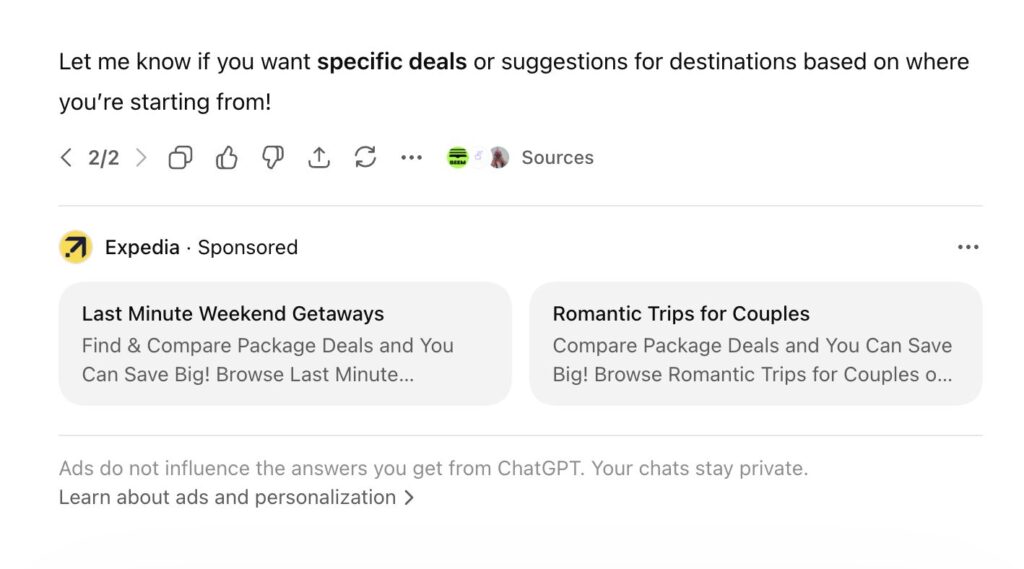
ChatGPT ads appear below the AI’s organic response, never interrupting it. They are clearly labeled as “Sponsored” and visually distinct from the answer. There are two primary formats in the current pilot:
Format 1: Shopping product carousel
Triggered by product-intent queries. Displays a horizontal selection of sponsored items with pricing, images, and a direct purchase path with Etsy and Shopify integration, allowing purchase completion inside ChatGPT. Think Google Shopping, but embedded inside the AI’s response layer.
Format 2: Conversational brand banner
A branded unit below the response that invites the user to continue a conversation directly with the advertising brand. Instead of a landing page redirect, users ask ChatGPT follow-up questions about the product within the same interface. This format has no real equivalent in traditional digital advertising; it transforms an ad into a dialogue.
The surprise nobody predicted
Early expectations held that ads would only appear after extended conversations — once the AI had built up enough context. Reality: ads now appear on a user’s very first message. A person who opens ChatGPT cold and asks ‘What’s the best way to book a weekend away?’ can receive a sponsored Expedia placement immediately. This first-prompt behavior is a fundamental departure from what the industry anticipated.
Targeting: Intent first, not cookie first
This is where ChatGPT advertising diverges most sharply from Google and Meta. There are no keyword-level bidding controls advertisers cannot target specific queries. Instead, OpenAI’s contextual system matches ads using:
- The live conversation topic (current query context)
- General location and language
- Past chat history – if the user has opted into personalised ads
- ChatGPT Memory – if both memory and personalised ads are enabled
- Previous ad interactions within ChatGPT
What advertisers never receive: individual chat transcripts, chat history, user names, email addresses, precise location, or IP addresses. Only aggregate performance data views and clicks are shared with advertising clients.
Privacy rules, user controls & ad safeguards
OpenAI has built a set of guardrails that matter to both users and brands. The platform’s stated principle:
OpenAI’s official ad policy (January 16, 2026)
“Ads do not influence the answers ChatGPT gives you, and we keep your conversations with ChatGPT private from advertisers. Ads are labeled as sponsored and visually separate from the response.”
Topic restrictions
Privacy safeguards prevent ads from appearing near sensitive topics. Ads are restricted from serving alongside discussions involving health, mental health, and politics. Users under 18 during testing will not see ads.
User controls
Users retain meaningful control through Settings > Ad Controls, allowing them to:
- Dismiss specific ads and provide feedback
- View exactly why a particular ad appeared
- Clear all advertising interaction data
- Manage and opt out of personalised ad targeting
- Free users who opt out of ads receive fewer free daily messages as a trade-off
The backlash and why OpenAI should have seen it coming
The launch didn’t arrive without turbulence. OpenAI had already learned a painful lesson months earlier.
In late 2025, before the official rollout, ChatGPT began surfacing random app suggestions mid-conversation. One viral incident involved a $200/month Pro subscriber seeing a Peloton app suggestion during an unrelated discussion about Elon Musk and xAI. The screenshot spread across social media. OpenAI’s Chief Research Officer disabled the feature within a single weekend.
Post-launch sentiment: the numbers
After the Feb 9 launch, 68% of Reddit discussion threads expressed negative sentiment. X (Twitter) conversation drew over 10 million views, predominantly skeptical. Anthropic ran Super Bowl ads with the tagline: “Ads are coming to AI. But not to Claude.” a direct competitive shot at OpenAI’s decision.
There’s also a documented technical irony. AdExchanger reported that when users asked ChatGPT directly where ads would appear within its interface, the chatbot gave incorrect answers. An OpenAI spokesperson confirmed the chatbot’s explanation was false illustrating the gap between advertising infrastructure and the model’s own understanding of its monetization layer.
The backlash reflects a deeper tension every ad-supported AI platform will have to navigate: users came to ChatGPT precisely because it felt different from the commercial web. The moment it begins to resemble a monetized feed, the trust that made it valuable starts to erode. The bar for AI assistants is higher than for search or social because they’re framed as helpers, not media surfaces.
Why OpenAI had no choice
Sam Altman called advertising a “last resort” as recently as May 2024, telling a Harvard Business School audience that “ads-plus-AI is sort of uniquely unsettling to me.” By January 2026, the same company confirmed the ad launch. The numbers explain the reversal.
| 800M+ Weekly Active Users | ~5% Who Actually Pay | $115B Projected Cash Burn to 2029 | $25B Projected Ad Revenue by 2029 |
OpenAI generates roughly $300 million in monthly revenue primarily from subscriptions. But only about 5% of its 800 million weekly active users pay for the product. Internal documents reported in mid-2025 showed OpenAI planning $1 billion in free-user monetization starting in 2026, scaling to $25 billion by 2029.
At that scale, advertising isn’t one option among many. It’s the only lever large enough to change the financial trajectory.
What marketers should do right now?
Whether your budget qualifies for the pilot or not, there are concrete, high-value actions every marketer should take today.
If you have $200K+ getting into the pilot
- Register advertiser interest at openai.com/advertisers
- Or engage through Criteo’s platform – now that Criteo is the first official ad tech partner, brands with existing Criteo relationships can access ChatGPT inventory through a familiar buying interface
- Push hard for attribution clarity before committing – OpenAI’s measurement infrastructure is still early-stage
- Test the conversational banner format first – it’s more native to the medium and less likely to generate user backlash than product carousels
- Target high-intent discovery queries, not informational ones – the ad unit works best when the user is already in consideration mode
If you’re not in the pilot yet, what you can do today
- Optimize for organic ChatGPT visibility now – ads appear below organic responses, so a strong organic presence gives you two visible positions on one query
- Build AEO-structured content – clear question-and-answer format, FAQ schema, How-To markup, and Article schema to improve AI extractability
- Audit your brand’s current appearance in ChatGPT responses – ask ChatGPT questions in your category and document where you show up and where competitors appear
- Track LLM-referred traffic in your analytics – Criteo data shows ChatGPT-referred users convert at 1.5x the rate of other referral channels. You may already be getting high-value traffic from AI without measuring it
- Prepare a structured product feed – the shopping carousel format requires clean product data. Get it ready now so you can activate quickly when access opens
The organic opportunity is right now
Seer Interactive’s analysis of 206,412 ChatGPT responses across 43 brands found a significant organic ranking algorithm shift beginning December 1, 2025 – 46 days before the public ad announcement on January 16, 2026. OpenAI was restructuring how organic results appear before introducing paid placements. Brands that build organic ChatGPT visibility now are building the foundation that paid ads will layer on top of.
The bigger picture a market splitting in real time
ChatGPT’s launch isn’t just an OpenAI story. It’s the opening move in a platform war being fought across every major AI interface:
| Platform | Ads Status | Model |
| ChatGPT | Live Feb 9, 2026 | $60 CPM / $200K min. pilot |
| Google AI Overviews | Integrated with the Google Ads ecosystem | Contested/denied |
| Perplexity | Contested/denied | Chose subscription-only model |
| Claude (Anthropic) | Publicly ad-free | “Ads are coming to AI. Not to Claude.” |
| Gemini | Contested / denied | Google VP denied 2026 ad rollout plans |
The idea that AI could remain neutral, free, and ad-free forever was always a financial fantasy. The real question, the one that will define the next decade of digital marketing, is whether advertising can adapt to a medium that punishes irrelevance instantly.
In traditional search and social media, a misplaced ad is ignored. In a conversational AI interface, a misplaced ad breaks the experience entirely. The tolerance for poor ad quality is near zero.
Get it right, and conversational AI becomes the most powerful intent signal marketers have ever had access to. Get it wrong, and the trust collapse accelerates the entire industry into a worse position than where it started.
FAQs: quick answers for marketers
How much does it cost to advertise on ChatGPT?
The CPM rate is approximately $60 per thousand impressions, with a minimum advertiser commitment of $200,000 to enter the current pilot. Some early advertisers were asked for $250,000. This makes ChatGPT ads comparable in cost to NFL broadcast inventory, significantly more expensive than Meta or Google.
Which brands are currently advertising on ChatGPT?
Confirmed early advertisers include Expedia, Best Buy, Enterprise Mobility, Qualcomm, The Knot Worldwide, Adobe, Ford, Mazda, Mrs. Meyer’s, Audible, Audemars Piguet, Target, Albertsons, Williams-Sonoma, Kroger, Mercedes-Benz, JPMorgan Chase, and Estée Lauder. Holding companies WPP, Omnicom, and Dentsu are the three agency groups managing the majority of early placements.
How do I buy ads on ChatGPT?
Currently, there are two routes: (1) Direct through OpenAI via openai.com/advertisers with a minimum $200K commitment, or (2) Through Criteo’s platform, confirmed as the first ad tech partner as of March 2, 2026, which will allow Criteo’s 17,000 global advertisers to access ChatGPT inventory through their existing Criteo accounts.
Do ChatGPT ads affect what the AI says in its responses?
According to OpenAI’s official policy, ads do not influence the content of ChatGPT’s responses. Answers are determined solely by what the algorithm deems most helpful. Advertisers receive only aggregate performance data, total views, and clicks and never have access to individual user conversations, chat history, or personal identifying information.
Can users avoid seeing ads on ChatGPT?
Plus ($20/month), Pro ($200/month), Team, Business, Enterprise, and Education subscribers do not see ads. Free and Go ($8/month) users see ads by default. Free users can opt out of personalised ads via Settings > Ad Controls, though doing so results in fewer free daily messages. Full ad-free access currently requires a paid subscription.
What is the conversion rate for ChatGPT-referred traffic?
Criteo’s early February 2026 data, drawn from a sample of 500 U.S. retailers, found that users referred from LLM platforms like ChatGPT convert at approximately 1.5 times the rate of other referral channels. The sample is early-stage and limited, but the directional signal is significant and suggests high purchase intent among AI-referred users.
The bottom line
ChatGPT ads are live. The minimum is $200,000. The CPM is $60. The first confirmed brands are Expedia, Best Buy, Enterprise Mobility, and Qualcomm. The first holding companies are WPP, Omnicom, and Dentsu. The first ad tech partner is Criteo.
The $200K threshold means most businesses are not yet buyers. But every marketer is already affected because ads and organic results will compete for the same answer space on every high-intent query from this point forward.
The brands that win won’t necessarily be the ones who buy ads first. They’ll be the ones who understand how conversational AI discovers, evaluates, and recommends, and who build visibility, trust, and structured content before the channel fully opens.
Want to win in the new era of advertising, contact today for a GTM strategy through ChatGPT ads.