
- The web consensus framework for LLM visibility
- 1. The new reality: AI has replaced the search results page
- 2. How AI systems actually find and validate your brand
- 3. The web consensus framework: 4 stages of AI visibility
- 4. Why most brands never appear in AI answers
- 5. The new disciplines: SEO, AEO, LLMO, and GEO, and what each one means
- 6. Where brands must build presence, the three ecosystems AI relies on
- 7. Platform-specific strategies that each AI engine prioritizes
- 8. The AI visibility playbook: practical steps by priority
- Priority 1: Build third-party mention density (0.664 correlation, highest impact)
- Priority 2: Activate community presence (4-7x citation multiplier on Reddit/Quora)
- Priority 3: Structure owned content for AI extraction
- Priority 4: Build Wikipedia and knowledge platform presence
- Priority 5: Measure, Monitor, and Iterate
- 9. The future of AI discovery: what comes next
- FAQs
The web consensus framework for LLM visibility
Two brands. Same industry. Same budget. Same Google rankings. One appears in ChatGPT’s answers every single time someone asks a category question. The other doesn’t exist in AI at all.
This isn’t random. It isn’t luck. And it has almost nothing to do with your SEO score.
The brands that show up in AI answers have earned something that traditional search optimization doesn’t measure: web consensus. They are the brands, the web, the communities, the platforms, and the knowledge ecosystems collectively agreed are credible, relevant, and trustworthy within their category. AI systems don’t rank pages; they read the entire web and synthesize who the authoritative answer-givers are.
This guide explains exactly how that works and gives you the complete framework for making your brand one of them.
| 2.5B+ Daily ChatGPT Prompts | 67% of Discovery Moving to AI by 2026 | 60%+ Google Searches End With Zero Clicks | 85% AI Brand Mentions From Third-Party Sources |
1. The new reality: AI has replaced the search results page
For decades, the game was simple. You optimized for Google. You ranked on page one. Customers clicked through to your website. The entire digital marketing industry was built around this loop.
That loop is breaking.
The Zero-Click Reality
Over 60% of Google searches already end without a single click and that number grows every quarter. Meanwhile, ChatGPT processes over 2.5 billion prompts daily. Forrester reports 89% of B2B buyers have adopted generative AI as a central source for self-directed research throughout their buying process.
The shift is structural, not cyclical. Users who once typed keywords into Google now ask ChatGPT for recommendations, use Perplexity for real-time research, and rely on Google AI Overviews for quick answers. Each of these systems does the same fundamental thing: they synthesize information from across the web and deliver a single, curated answer.
They don’t show ten links. They show one answer. You are either in that answer, or you are invisible. There is no page two.
The five AI answer engines that matter in 2026
| Platform | Weekly Users | Primary Strength | Content Priority |
| ChatGPT (OpenAI) | 900M+ | Broadest reach; conversational AI + search | Wikipedia, UGC, referring domains |
| Google AI Overviews | Billions | Integrated into Google Search results | High E-E-A-T, structured data |
| Perplexity AI | Growing | Real-time retrieval; 6-10x higher CTR | Content freshness (40% weight) |
| Microsoft Copilot | Millions | Office 365, Windows, Edge integration | Microsoft ecosystem signals |
| Claude (Anthropic) | Growing | Enterprise and B2B workflows | Entity verification (30% weight) |
The Platform Divergence Problem
A brand that appears prominently in ChatGPT responses may be entirely absent from Gemini and vice versa. Hootsuite’s 2026 LLM visibility analysis confirmed that different models use different training corpora and different real-time retrieval signals. ChatGPT shows only 8% overlap with Google and Bing results. Perplexity shows 28% overlap. Comprehensive AI visibility requires tracking across at least four platforms simultaneously.
2. How AI systems actually find and validate your brand
Before building a strategy, you need to understand the mechanics. AI systems don’t discover your brand the way Google’s crawlers index a page. The process is fundamentally different, and most brands are optimizing for the wrong signals entirely.
Two pathways into every AI answer
Every AI answer engine uses two parallel pathways to surface brand information:
Pathway 1: Training data
The model has already processed web content from before its knowledge cutoff and formed associations between your brand, your topics, and authority signals. This data is baked into the model’s weights. Changing it requires influencing what gets published, cited, and discussed across the web over time.
Pathway 2: Real-time web crawl
Models like Perplexity and GPT-4o with browsing fetch current content at the moment of the query. This pathway responds to fresh content, recent citations, and up-to-date third-party mentions. It is immediately actionable.
The strategic implication: short-term tactics primarily influence Pathway 2 (Perplexity in particular). Long-term brand presence affects Pathway 1 the foundational layer that influences every model’s understanding of your authority.
The six ranking factors with correlation data
ConvertMate’s proprietary analysis of 80 million citations across ChatGPT, Perplexity, Gemini, and Claude identified six core factors that determine AI visibility. These are not guesses or best practices; they are measured correlations:
| Factor | Weight in AI Score | What It Measures | Key Action |
| Brand Web Mentions | 35% #1 factor | How often your brand is referenced across news, publications, forums, reviews | PR, community presence, earned media |
| Position Prominence | 20% | Whether you appear first or are buried in a list of recommendations | Become the default answer, not an option |
| Domain Authority | 15% | Technical trust signals from your website | E-E-A-T, structured data, schema markup |
| Content Freshness | 15% | How recently content was published or updated (3.2x multiplier for 30-day refreshes) | 30-day content refresh cycle |
| Structured Data | 10% | Schema markup enabling AI to extract answers cleanly | FAQ, HowTo, Article, Product schemas |
| Technical Performance | 5-10% | Crawlability, server-side rendering, page speed | Ensure AI bots can actually read your site |
The finding that changes everything
ConvertMate’s data shows that traditional Domain Rating (DR), the primary metric most SEO tools focus on, actually shows a NEGATIVE correlation with AI citations. The rules have fundamentally changed. High Google authority does not equal high AI visibility. The #1 factor is Brand Web Mentions at a 0.664 correlation, nearly double the next strongest signal.
3. The web consensus framework: 4 stages of AI visibility
AI visibility isn’t a single switch you flip. It is a four-stage ecosystem that builds on itself. Brands that appear consistently in AI answers have usually, without knowing it, built all four layers. Brands that are invisible have typically failed at Stage 3.
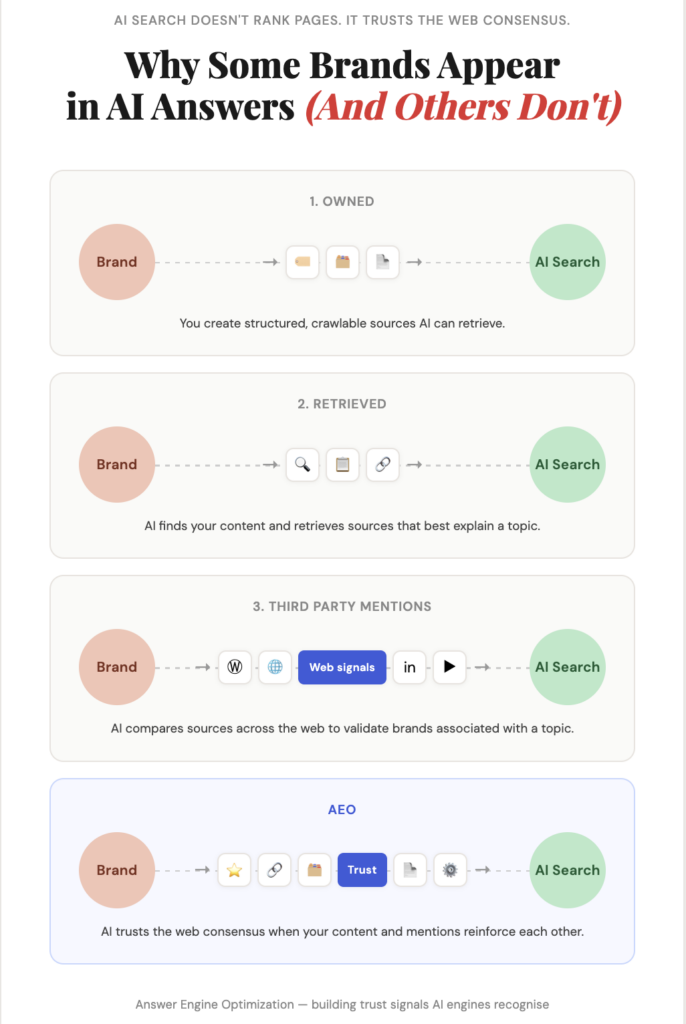
Stage 1: Owned content
What you publish and control the foundation AI systems retrieve from
- Structured blog articles, knowledge guides, research content, and documentation
- Content organized around clear questions your customers ask, not keywords
- Semantic HTML with clean H1/H2/H3 hierarchy (many LLM bots cannot render JavaScript)
- Server-side rendering AI crawlers rely heavily on initial HTML, not JavaScript
- Clear definitions, explanatory examples, and data-backed claims
- Regular 30-day refresh cycles with visible timestamps (3.2x citation multiplier)
Stage 2: Retrieved content
What AI engines actually pull and surface when your category is queried
- Semantic relevance AI matches by concept and intent, not keyword density
- Topic authority being the definitive source on a subject, not just mentioning it
- Content depth: shallow content is ignored; comprehensive guides are preferred
- AEO-structured formatting: FAQ sections, definition blocks, numbered steps, comparison tables
- Schema markup: Article, FAQ, HowTo, Product, and LocalBusiness in JSON-LD format
- Schema markup delivers a verified 67% improvement in AI citation rates
Stage 3: Third-party mentions
The most underestimated and highest-impact stage of external validation across the web
- 85% of brand mentions in AI responses come from third-party content, only 13% from brand-owned domains
- Reddit and Quora participation drives 4-7x citation increases, the highest multiplier of any single tactic
- Wikipedia’s presence in ChatGPT predominantly cites Wikipedia as a primary source
- LinkedIn thought leadership, especially for B2B and professional category queries
- Industry publications, PR placements, journalist citations, and earned media
- User reviews, community discussions, and forum contributions
- Each unique domain that mentions your brand strengthens topic association in AI training data
Stage 4: AEO trust & web consensus
The emergent result when all three layers combine is the state where AI consistently cites you
- AI systems build confidence through repeated signals across independent sources
- Trust emerges when: your site is authoritative + third parties mention you + communities discuss you
- This creates a pattern AI recognizes as consensus, not just one source, but the web agrees
- Brands at Stage 4 appear across multiple AI platforms, not just one
- Web consensus is compounding; each new mention reinforces prior associations in the model
- Stage 4 brands don’t optimize for AI; they have become the reference standard in their category
4. Why most brands never appear in AI answers
Most brands are invisible in AI, not because they are bad but because they are optimizing for the wrong signals. Here are the five most common failure patterns, each verified by research data:
Failure 1: Weak third-party presence
The single biggest mistake. If 85% of AI brand mentions come from third-party content, a brand with excellent owned content but no external mentions is operating at 13% of the available signal. Most brands invest 90% of their content budget in owned channels, inverting exactly the ratio that AI systems respond to.
Failure 2: No community footprint
Reddit and Quora participation produce 4-7x citation increases, yet most brands have zero authentic presence on either platform. AI systems are designed to feel human and answer questions the way people naturally respond. Platforms where humans answer real questions authentically are disproportionately weighted in AI training data. Brands that treat Reddit as a minor channel are missing the highest-leverage lever in AI visibility.
Failure 3: Keyword content, not concept content
LLMs don’t match keywords; they understand concepts. Optimizing for “engineering productivity software” means being the definitive source on questions about measuring, improving, and understanding engineering productivity, not just mentioning the phrase repeatedly. Brands built on keyword-density SEO strategies are structurally invisible to AI engines.
Failure 4: Promotional tone
AI systems prefer educational, informational content over promotional content. A product page that explains why your solution is best is not what AI cites. A comprehensive guide that explains how to solve the problem your solution addresses, written without reference to your brand name, is the content that earns citations.
Failure 5: Technical inaccessibility
Many LLM bots cannot render JavaScript. If your website relies on JavaScript to display content, AI crawlers may see a blank page. Server-side rendering and clean semantic HTML are non-negotiable technical requirements for AI visibility. Additionally, content that isn’t structured with schema markup gives AI engines no signal about what type of answer your content provides.
The invisible brand test
Open ChatGPT, Perplexity, Gemini, and Claude in four separate incognito tabs. Ask the question your ideal customer asks when researching your category. Document every brand that appears. If yours isn’t there, you now know exactly why. This 30-minute audit is the most valuable marketing intelligence exercise available today.
5. The new disciplines: SEO, AEO, LLMO, and GEO, and what each one means
The terminology around AI search optimization is fragmented because the category is new and every vendor is racing to define it. Here’s the clearest breakdown available:
| Traditional SEO | AEO / LLMO / GEO |
| Goal: Rank on page one of search results | Goal: Be cited as the source in AI-generated answers |
| Metric: Keyword rankings and organic traffic | Metric: Brand citation frequency and AI share of voice |
| Target: Google’s ranking algorithm | Target: LLM training data and real-time retrieval signals |
| Key tactic: Backlinks and domain authority | Key tactic: Third-party mentions and community presence (0.664 correlation) |
| Content format: Keyword-optimized pages | Content format: Question-answering structures, FAQ schema, definitions |
| Success: Page 1 position | Success: The only answer AI doesn’t show page 2 |
| Primary signal: Domain Rating (DR) | Primary signal: Brand web mentions (DR shows NEGATIVE correlation in AI) |
| Timeline: Weeks to months | Timeline: Months to years for training data; weeks for real-time retrieval |
AEO (Answer Engine Optimization) is the practice of optimizing content to be cited by ChatGPT, Google AI Overviews, Perplexity, and Bing Copilot. LLMO (Large Language Model Optimization) focuses specifically on influencing the sources AI models learn from, such as thought leadership, research, and industry frameworks that shape training data. GEO (Generative Engine Optimization) is the broader discipline covering both. The strategic objective is the same regardless of the label: make your brand the reference standard in your category across the web.
6. Where brands must build presence, the three ecosystems AI relies on
AI visibility is not built on one platform. It is built by showing up consistently across three interconnected ecosystems that AI systems draw from as their primary sources of validation.
Ecosystem 1: Knowledge platforms are the foundation of AI trust
These are the sources AI systems cite most frequently when establishing factual claims and definitional authority:
- Wikipedia is ChatGPT’s most-cited single source. If your brand, your founder, or your category framework has a Wikipedia entry, you have a direct line into AI training data. Wikipedia citations are among the highest-authority signals in LLM training corpora.
- Industry publications, academic journals, and research papers, AI systems are trained to prioritize peer-reviewed and editorially rigorous sources
- Government and institutional data sources are particularly valuable for regulatory and compliance-adjacent industries
- Brand-published research, proprietary studies, and original data, when picked up and cited by third parties, are among the most powerful LLMO signals available
Ecosystem 2: Community platforms the authenticity signal AI weighs most
This is the most underestimated ecosystem in AI visibility and the one with the highest measurable impact:
- Reddit 4-7x citation increase for brands with an authentic Reddit presence. AI systems are disproportionately trained on Reddit because it contains real human questions and real human answers at scale. A helpful, authentic answer to an industry question on a relevant subreddit is one of the highest-leverage AI visibility investments available.
- Quora: Similar dynamics to Reddit; expert answers on Quora are indexed, cited, and heavily weighted in AI training data.
- Product review platforms (G2, Capterra, Trustpilot) user-generated validation that AI systems treat as authentic social proof
- Industry forums, niche communities, and professional networks, topic-specific communities signal category authority
Ecosystem 3: Professional and editorial platforms, the authority layer
- LinkedIn thought leadership is especially critical for B2B brands. Long-form LinkedIn articles by founders, executives, and subject-matter experts create professional authority signals that AI systems weigh heavily for enterprise and B2B category queries.
- Journalist citations and earned media mentions in TechCrunch, Forbes, or a vertical industry publication carry significant weight in AI training data
- Guest contributions and bylines published thought leadership on third-party sites create the external mention density that drives AI citations
- Podcast appearances and video content are increasingly indexed and cited, particularly where transcripts are published
The compound effect
Each ecosystem reinforces the others. A research study you publish (Knowledge) gets discussed on Reddit (Community) and then covered by a journalist (Professional/Editorial). That single piece of original research can generate citations across all three ecosystems simultaneously, compounding your AI visibility signal far beyond what any individual tactic achieves alone.
7. Platform-specific strategies that each AI engine prioritizes
Because AI engines use different training data and different real-time signals, a strategy that works for ChatGPT may underperform for Gemini. Here is what each platform prioritizes, based on ConvertMate’s cross-platform citation analysis:
| Platform | Top Ranking Signal | Best Content Type | Priority Action |
| ChatGPT | Referring domains (30%) | Wikipedia, UGC, community discussions | Prioritize Wikipedia presence and Reddit engagement |
| Perplexity AI | Content freshness (40%) | Recently published, frequently updated | 30-day content refresh cycle; date-stamp all updates |
| Google Gemini | E-E-A-T signals (35%) | Expert authorship, structured data | Author schema, credential signals, Google Business Profile |
| Microsoft Copilot | Microsoft ecosystem integration | LinkedIn, Office-native formats | LinkedIn thought leadership; Microsoft partner mentions |
| Claude | Entity verification (30%) | Factually precise, entity-rich content | Wikipedia entries; consistent brand entity across the web |
The practical implication: Perplexity is the fastest platform to influence because freshness is its primary signal. ChatGPT requires the broadest web presence strategy. Gemini rewards traditional E-E-A-T investments that overlap with good SEO. Claude penalizes brands with inconsistent entity information across the web brand named differently across LinkedIn, Wikipedia, and its own website will underperform in Claude.
8. The AI visibility playbook: practical steps by priority
This is the complete, prioritized action plan based on measured impact data. Steps are ordered by correlation strength and implementation difficulty.
Priority 1: Build third-party mention density (0.664 correlation, highest impact)
- Launch a digital PR campaign specifically targeting AI-cited publications, industry press, trade journals, and tech publications
- Publish original research with quotable statistics and data points that get cited far more than opinion
- Pitch guest articles and expert commentary to publications your customers read
- Set a target of 20+ unique domain mentions per quarter, mentioning your brand in a substantive context
- Track mentions using brand monitoring tools and verify which sources AI systems actually cite in your category
Priority 2: Activate community presence (4-7x citation multiplier on Reddit/Quora)
- Identify the top 5-10 subreddits where your target customers discuss problems you solve
- Create or dedicate a team member to providing genuinely helpful, non-promotional answers to community questions
- Answer relevant Quora questions in your category focus on comprehensiveness and expertise, not brand promotion
- Monitor threads where your brand or competitors are mentioned and engage authentically
- The rule: help first, exist as a brand second. Communities detect and reject promotional intent instantly
Priority 3: Structure owned content for AI extraction
- Restructure existing content around question-answer pairs. What is X? How does X work? When should you use X?
- Implement FAQ schema, HowTo schema, Article schema, and Product schema in JSON-LD format (67% improvement in citation rates)
- Ensure server-side rendering for all key content pages that AI bots cannot render JavaScript
- Establish a 30-day content refresh cycle with visible timestamps (3.2x citation multiplier for fresh content)
- Add an explicit definitions section to every major piece of content. AI systems prioritize clear, extractable definitions
Priority 4: Build Wikipedia and knowledge platform presence
- If your brand, your founder, or your core framework doesn’t have a Wikipedia entry, create one (following Wikipedia’s guidelines for notability)
- Ensure consistent brand entity information across Wikipedia, LinkedIn, Crunchbase, and your own site
- Publish proprietary research and data that journalists and academics can cite; becoming a primary source is the highest-value LLMO investment
- Build Wikidata entries and ensure structured knowledge graph presence
Priority 5: Measure, Monitor, and Iterate
- Run the AI Visibility Audit weekly: query your core category terms across ChatGPT, Perplexity, Gemini, and Claude in incognito mode
- Track LLM-referred traffic in your analytics (referral source: chatgpt.com, perplexity.ai, claude.ai)
- Use dedicated AI visibility tools: Profound, Geneo, LLMrefs, ZipTie.dev, or HubSpot’s free AEO Grader
- Monitor your AI share of voice vs. competitors who are being cited when your category is queried?
- Set quarterly targets for citation frequency, sentiment polarity, and position prominence
9. The future of AI discovery: what comes next
We are in the earliest phase of a shift that will take a decade to fully resolve. Here is what the evidence suggests about where this is heading:
Agentic search will replace passive search
AI systems are moving from answering questions to completing tasks autonomously. When an AI agent books a hotel, recommends a vendor, or places an order on a user’s behalf, the brands that are cited are the brands that win. Agentic AI doesn’t present options it makes decisions. AI visibility stops being about getting cited and starts being about being selected. The brands building visibility infrastructure now are positioning for the agentic era.
AI citations will replace backlinks as the primary trust signal
The SEO industry spent twenty years optimizing for Google’s backlink graph. A parallel infrastructure AI citation graphs is being built right now. Early data from Salespeak shows companies that implemented AEO strategies saw ChatGPT-driven referrals increase by 100% in 8 weeks. The brands that establish citation authority now will compound that advantage as AI usage accelerates.
The zero-click economy will expand
Perplexity already drives 6-10x higher click-through rates than ChatGPT for AI-cited brands, and conversion rates from Perplexity traffic run 20-30% on high-intent pages. But the broader trend is toward fewer clicks, not more. Brands that depend on click-through traffic as their primary growth signal are structurally exposed as AI abstracts more of the discovery layer away from direct website visits.
“As more companies recognize that buyers research in ChatGPT before Google, competition for LLM visibility will intensify. The companies establishing AEO practices now will have significant advantages: content authority, technical infrastructure, and institutional knowledge of what works for LLM visibility.”
Salespeak.ai, AEO guide 2026
FAQs
What is the difference between AEO, LLMO, and GEO?
AEO (Answer Engine Optimization) is the practice of structuring content to be cited in AI-generated answers from platforms like ChatGPT, Perplexity, and Google AI Overviews. LLMO (Large Language Model Optimization) focuses on influencing the sources that train AI models through thought leadership, research publications, and industry frameworks. GEO (Generative Engine Optimization) is the broader discipline covering both. All three terms describe the same strategic objective: making your brand the authoritative, default citation in your category across AI answer engines.
Why does my brand appear on Google but not in ChatGPT?
Because the signals that drive Google rankings and the signals that drive AI citations are fundamentally different. ConvertMate’s analysis of 80 million citations found that traditional Domain Rating, the primary metric SEO tools optimize for, shows a negative correlation with AI citation rates. The #1 factor for AI visibility is Brand Web Mentions (0.664 correlation) how often your brand is referenced across news, forums, publications, and reviews. Google ranks pages; AI systems validate brands through web consensus.
How long does it take to improve AI search visibility?
It depends on the pathway. For Perplexity, which weights content freshness at 40%, well-structured new content can influence citations within weeks. For ChatGPT and Claude, which draw heavily on training data, building meaningful visibility typically takes 3-6 months of consistent third-party mention building and content strategy execution. Building the foundational web consensus that drives Stage 4 visibility is a 12-24 month investment for most brands in competitive categories.
What type of content gets cited most in AI answers?
Based on ConvertMate’s citation analysis and platform research: Wikipedia entries, Reddit and Quora community discussions, industry publications, and earned media, original research with citable data points, and structured FAQ and HowTo content with schema markup. User-generated content platforms dominate AI citations because AI systems are designed to respond the way humans naturally answer questions. Content that is educational rather than promotional, question-structured rather than keyword-optimized, and data-backed rather than opinion-led consistently outperforms promotional brand content.
Which AI platform should I optimize for first?
Start with ChatGPT for the broadest immediate reach, over 900 million weekly active users. Add Perplexity second because its real-time retrieval model makes current content and fresh third-party citations immediately actionable without waiting for training data updates. Add Gemini, third, given its integration with Google Search. Prioritize Claude for B2B and enterprise brands, where Claude’s growing adoption in professional workflows makes it an increasingly important visibility channel.
How do I measure AI search visibility?
The baseline audit: open ChatGPT, Perplexity, Gemini, and Claude in separate incognito windows and query your core category terms. Document every brand cited. Then track: citation frequency (how often you appear across platforms), position prominence (whether you appear first or buried), sentiment polarity (whether the mention is positive), and LLM-referred traffic in your analytics (referral sources: chatgpt.com, perplexity.ai, claude.ai). Dedicated tools include Profound, Geneo, LLMrefs, ConvertMate, and HubSpot’s free AEO Grader.
The Formula: Content + Retrieval + Mentions + Trust = Web Consensus
AI visibility doesn’t come from gaming an algorithm. It comes from building the kind of brand the web collectively agrees is authoritative, credible, and trustworthy in its category.
The brands that win AI search will be the brands that have built all four layers of the Web Consensus Framework: owned content AI can retrieve, structured content AI can extract, third-party mentions AI can validate, and accumulated trust signals that create the pattern AI recognizes as consensus.
The window for first-mover advantage is open right now. Most brands haven’t started. The content authority, community presence, and citation infrastructure you build in the next 12 months will compound for years. In AI search, visibility belongs to the brands the web trusts, and trust is built by showing up consistently across every platform that matters.
Start here: Your 30-minute AI visibility audit
Open ChatGPT, Perplexity, Gemini, and Claude in four incognito tabs. Ask the three questions your ideal customer asks when researching your category. Document every brand that appears. If you’re not there, you now have the framework to change that. Start with Priority 1: build third-party mention density. It has a 0.664 correlation with AI citations, the single highest-impact action available.
The sooner you understand why some brands appear in AI answers and others don’t, the sooner you will be able to create your LLMO and AEO strategies to gain visibility. Contact today if you want to go through the transformation.